

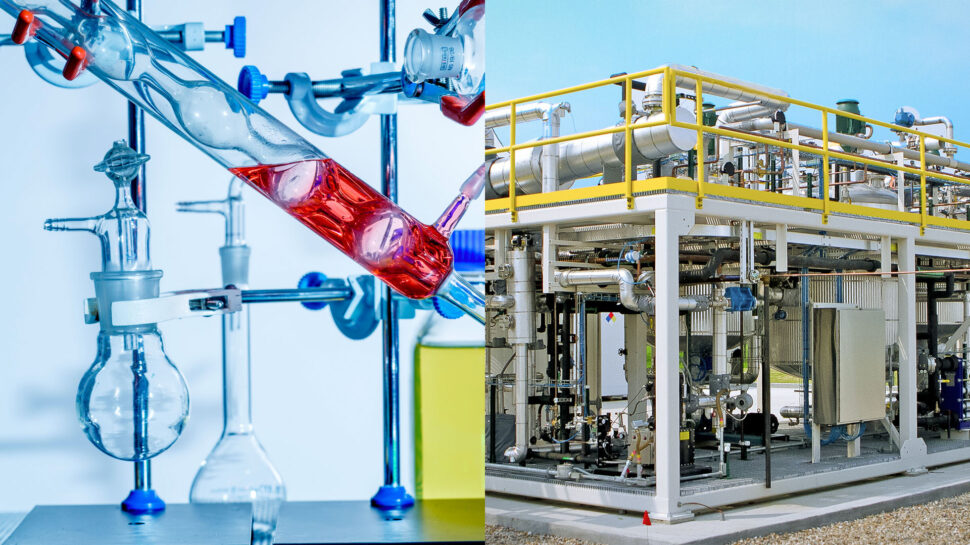
Scaling Novel Polymers: Challenges and Pathways to Commercial Success
This white paper outlines the motivations, technical challenges, and practical recommendations for successfully scaling novel polymer and plastic materials. As new application spaces open, performance standards rise, and sustainability mandates grow stricter, the demand for advanced materials continues to increase. Biobased content, compostability, high-performance blends, and regulatory-safe chemistries are all driving innovation. Yet despite the flurry of patents and academic literature on novel materials, few make it beyond the bench.
Why? The barriers are numerous and often compound at scale: economic feasibility, raw material sourcing, processing limitations, and real-world performance gaps are just a few. Commercializing a polymer or plastic involves more than scientific merit—it requires a robust, scalable, and reproducible process, a supply chain that can deliver, and the ability to meet tight quality specifications over time.
At Polymer Consulting Group (PCG), we’ve supported the development and scale-up of novel materials from gram-scale synthesis to hundreds-of-gallons production runs. While every technology is unique, certain lessons and approaches have consistently helped bridge the gap between promising lab results and real-world manufacturing.
Laying the Groundwork for Scale
One of the most critical success factors in polymer commercialization is designing with scale in mind from the outset. Many lab procedures, particularly in academia, are tailored for ease of experimentation rather than scalability. Methods that rely on highly specific timing, narrow temperature windows, or exotic solvents rarely translate well to production environments.
It is essential to imagine each step of the process at 100–1,000× scale. If you can’t envision what the operation looks like with drums or totes instead of vials—or what would happen if you paused for lunch mid-run—you’re likely missing a scale-dependent bottleneck. We strongly advocate for using scale-appropriate lab equipment early in development. Bench-scale reactors, jacketed vessels, or small twin-screw extruders that mimic industrial setups reduce surprises later on.
Simple is better. In our experience, “bucket chemistry”—that is, reactions that can be done robustly in basic vessels with simple controls—is far more likely to be successfully scaled than processes that depend on precision syringe additions or sensitive headspace management. That said, some processes are inherently complex, and when that’s the case, you must deeply understand the system’s limits. Factors like heat and mass transfer, viscosity, interfacial area, and cooling rates behave very differently across scale and geometry. These differences aren’t minor—they’re often the root cause of early pilot failures.
Embracing the Messiness of Polymers
Polymers—especially those derived from multifunctional or biobased feedstocks—tend to be messy. Molecular weight distributions, branching, unreacted monomers, or compositional drift are common. Perfect uniformity is rarely realistic in early scale-up phases. It’s important to recognize this and decide whether your application can tolerate some variability, or if a more refined synthesis strategy is needed. Either way, building in a tolerance for the inherent complexity of polymers is often wiser than trying to force the system into a level of definition that may not be achievable at scale.
From day one, collect process data. Even seemingly minor variables—ambient humidity, room temperature, impeller torque—can later help diagnose problems. We’ve seen failed scale-ups traced back to subtle changes like seal integrity or miscalibrated thermocouples. The earlier you start tracking the full process environment, the better equipped you’ll be when something unexpected occurs.
Another early priority is defining what makes a “good batch.” If you wait until the pilot run to set QC targets, it becomes difficult to determine what’s working and what isn’t. Quality criteria should be defined up front—not only final properties like tensile strength or Tg, but in-process indicators like viscosity, solids content, or pH. Similarly, storage and stability should not be afterthoughts. A material that performs well out of the reactor but degrades in a warehouse after 4 weeks can derail commercial interest.
Avoiding Common Technical Pitfalls
From our experience, five recurring technical pitfalls account for a large portion of scale-up failures:
- Something is different, but you don’t know what. Whether it’s a change in surface-to-volume ratio, a leaky seal, or latent moisture, many issues arise from subtle differences between bench and pilot. Often, oxygen and water are the uninvited guests. We’ve seen several cases where environmental humidity alone shifted the performance of sensitive formulations. Routine tracking of ambient conditions—simple to implement—has saved multiple projects.
- Unrealistic lab processing. In the lab, it’s easy to workaround process weaknesses by modifying sample handling, using solvent assist, or adjusting cycle times. These hacks aren’t always viable in a manufacturing setting. A clear-eyed distinction must be made between what’s working because it’s fundamentally sound vs. what’s working because someone is babysitting it.
- Relying on specialty additives that don’t scale. Specialty chemicals sourced from Sigma-Aldrich, Oakwood, or Fisher often don’t reflect commercial availability. It’s common to find that a compound used at 0.5% loading in the lab is only manufactured at 10 tons globally per year. Sanity check your feedstocks early using industrial semi-industrial suppliers (e.g., Univar, Spectrum, Alibaba, etc.). AI platforms (GPT, Grok, Gemini, etc.) can also be useful tools for identifying manufacturers and ballpark prices; however, you should always verify.
- Water. It's the culprit in more failures than most teams expect. Whether through hydrolysis, moisture absorption, or unwanted condensation, water can sabotage performance during synthesis, drying, storage, or downstream processing. Planning ahead for drying strategies, ambient tolerance, and resin stabilization is critical.
- Surface area effects. As scale increases, surface-to-volume ratios change dramatically, affecting not just heat transfer but reaction kinetics, diffusion, and oxidative stability. If you’re working with materials that are oxygen-sensitive, moisture-sensitive, or require long residence times, consider whether surface area will affect your outcome before running into trouble.
Recommendations for a Successful Path Forward
Every novel material will have its own challenges, but the path to commercialization tends to follow recognizable stages: validation, scale-up, stabilization, and deployment. One key piece of advice: define your minimum viable product (MVP) early and ensure alignment with customers or funding partners. In many cases, development drags not because the MVP failed—but because the goalpost moved. Trust your partners, but always verify that expectations are frozen before scaling commitments are made.
Finally, be realistic about the quantities needed. Potential customers often require tens of kilograms—even 100 kg or more—for evaluation. And few will pay for these pilots. Having a clear, feasible plan for how you’ll meet these quantities without breaking your budget (or compromising your process) is essential.
Scaling novel polymers isn’t easy—but with thoughtful planning, the right tools, and realistic expectations, it can be done. PCG has expertise in helping novel materials reach the market, bringing decades of collective experience in chemistry, engineering, analytics, and commercialization to every project we support. If you need help, please reach out.